


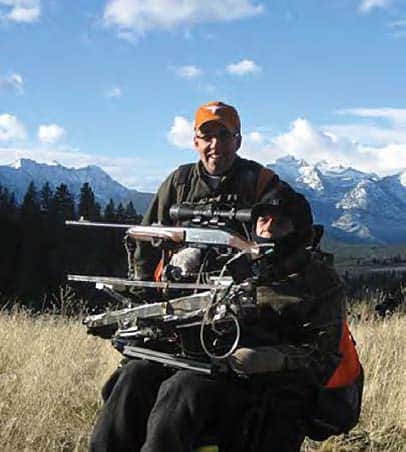
Hunting has long been part of the American experience, and it’s a pastime enjoyed by people from diverse backgrounds. Enjoying this sport is more difficult for those with limited mobility, but adaptive gun mounts and sip-and-puff gun triggers have made life easier for countless hunters with disabilities. Hunters from all parts of the country are getting out into the wild and bagging wide varieties of big and small game. The following three hunters from Montana and North Carolina have in their own unique way found solutions to not only enjoy a pastime they love, but to have great success while doing it.
Big Sky Hunter
Chris Clasby has spent most of his life hunting in scenic Big Sky country. The Montana native became a quad in 1990 but that wasn’t going to keep him from a passion that was in his blood. Months after the accident, he discovered adaptive equipment that would enable him to keep on hunting for many years.

Clasby would soon invest in an adapted gun mount from SR 77 Enterprises. His rifle needed modification, including having the stock cut off and a cable attached to the trigger before he could fire it independently. The mount is outfitted with controls that are easy to operate by those with very limited mobility. “I basically move the joystick with my chin to aim it where I want and then sip in a tube to fire it,” he says.
Using an adaptive device can take time to learn, but Clasby became proficient quickly. He likens it to becoming comfortable with shooting a new rifle. The technology, though, doesn’t necessarily make for a better hunter. “I think shooting well with anything has as much to do with practice and confidence as it does with the equipment you’re using,” he says.
Hunting big game is what Clasby loves most and over the years he’s bagged an assortment of elk, deer and antelope. The rugged terrain of Western Montana makes it difficult for him to get where the game is, but he uses his vehicle to access potential hunting areas. He doesn’t like hunting from the vehicle, which is permitted in Montana for people with disabilities, so he gets out of the van and hunts from his power wheelchair.
It has been years since Clasby acquired his disability, but he still hunts with many of the same friends he hunted with prior to his injury. He’s glad his friends have never wavered from the extra challenge it takes to hunt with him. It means a lot to Clasby to spend time in the outdoors with his friends. “It’s a great common bond to still equitably participate in something together,” he says. Family has also been a source of support for Clasby and he often hunts with them, too.
Clasby encourages people with disabilities who are interested in hunting to contact organizations that may be able to assist them or direct them to an appropriate resource. Good places to start include national groups like Safari Club International, Pheasants Forever or any state or local hunting group. He says you just have to start somewhere and fumble your way along. “We all like to have successes right away, but the most important thing is the journey to get there.”
Hunting With Dad
North Carolina native Devia Eller thought her days of hunting were over when a 1991 car accident left her a C4-6 quad with limited use of her left arm. Her journey to rediscovering hunting would be a long one, but this blue-eyed country girl was determined to hunt again. Thanks to numerous family, friends, and passionate hunters, this dream would be realized.

In 2007, Eller began an online quest to find adaptive hunting equipment and she soon stumbled across the Trophy Shot scope camera. The camera attaches to the rifle scope and displays the view on a small LCD screen. This eliminates the need for a person with a disability to look directly through the scope. She was put in contact with George Bolender, a quad in New York state whose organization Outdoors Unlimited purchased the device for Eller. Bolender also hooked her up with Ed Mays, the president of North Carolina Handicapped Sportsmen.
Eller phoned Mays and discussed her level of injury and the type of equipment she would need to hunt again. It wasn’t long before she was in the woods stalking her first deer in decades. NCHS organized a deer hunt in the fall of 2007 for 20 hunters with disabilities in Caldwell County, about three hours from Eller’s home. The three-day hunt would take place on easily-accessible land donated by private landowners.
An excited Eller equipped with the HQ100, a power gun mount from BE Adaptive, rolled into a hunting blind with her dad. Eller was so happy to be back with her father doing something they both loved. In the late fall afternoon, Eller spotted a six point buck in the distance. She used the mount’s chin-operated joystick to sight in her prey, and with a quick suck on a small tube she fired the rifle.
The buck was lying on the ground and it was an emotional moment for the woman from Glade Valley. “I hadn’t gone hunting with my dad since I was a teenager, so it made it bittersweet,” Eller says. “Not only did I get my first deer as a disabled hunter, but I did it with my dad.” The moment was so exciting that the feeling of being cold left her body immediately.
The next hunting opportunity occurred for Eller in 2008 and it would take her 1,700 miles across the country. Eller was one of 15 hunters selected to take part in a Wyoming antelope hunt. She says the event brought together wounded veterans, paras, quads, amputees and even a blind hunter. During the second day of the hunt, at 6:30 a.m., Eller bagged an antelope with a 249-yard shot. She says it was a wonderful experience and she’s happy to have had the chance to hunt in a different area of the country.
Eller frequently hunts on her father’s and neighbor’s land in areas she can access with her wheelchair. Nothing makes her happier than enjoying the peace and quiet of the great outdoors. Hunting also is therapeutic because it takes her back to a time when she was fully independent. “It makes me feel like I’m still able to go out there and do some of the things I enjoyed doing before my automobile accident,” Eller says.
She encourages others with disabilities to find a way to get out there and do what they love. She says it may take some searching but it can be done. “If you think it might be possible, if you think it’s something you want to do, and if you research it online, you’ll find a place that will give that to you,” she says.
Family Tradition
Hunting is not only a long-held tradition in the Wilke family — it’s a way of life. When Mikey Wilke was diagnosed with Duchenne muscular dystrophy as a child, it was thought he’d sadly miss out on the experience. However, Wilke’s determination combined with his family’s love and the kindness of strangers would prove otherwise.
A few years ago, Wilke expressed a serious interest in the family pastime and before long he was enrolled in a hunter safety course. Wilke breezed through the course, earning a perfect score on his exam. His uncle then contacted the Western Montana Chapter of Safari Club International and asked if they could help his nephew in his quest to hunt.
The hunting nonprofit contacted Craig Barrett, former Intel CEO and owner of the CB Ranch in Darby, Mont. Barrett invited Wilke down to the ranch to elk hunt, a kindness that amazed Wilke’s mother, Beverly. “He was so moved by the story that he told Mikey that he could shoot any sized elk that he wanted,“ Beverley says.
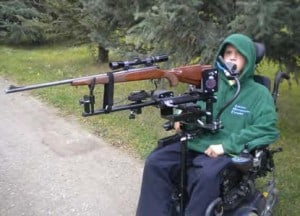
Plans were underway for Wilke’s hunt, but he’d need the necessary adaptive equipment. MonTECH, an assistive technology program for Montanans, loaned Wilke a gun mount with a sip and puff trigger. His father outfitted the 6mm rifle with an extended eye relief rifle scope that allowed his son to view the field from a distance. Outfitted with the right equipment, Wilke readied for the hunt by taking target practice at stationary clay pigeons.
The big day arrived on Nov. 16, 2010, and the 14-year-old Wilke was filled with excitement and anticipation. Hunting on 25,000 acres can be a huge challenge, but Wilke and his wheelchair were unloaded from the family Suburban near a ravine the elk were known to pass through. Other members of the hunting party tried spooking the elk toward the ravine, but the herd split up and went around the awaiting hunter.
A second attempt to spook the elk was made but the herd headed for higher ground. The sight of the massive migrating herd was breathtaking. “There are so many, it looked like a river of elk going up the mountain,” says Beverly. The family loaded back up and made their way to the other side of the ravine.
There, his uncle and father left on foot to survey the situation. They suddenly returned after spotting two bull elk on a nearby hillside. Wilke was quickly moved a short distance to a perfect viewing position. While the elk were lying down, father and son worked as a team to sight the elk into view. After several minutes, one of the elk stood up and Wilke dropped the six point elk with an accurate lung shot.
Months of preparation made this moment possible, and the hunting party erupted into celebration as a young man’s dream was realized. Bagging a bull elk is something few hunters achieve, but Wilke demonstrated that with determination and support, anything is possible. He says the experience felt really good and he now has more in common with his father.
This incredible experience has stoked a passion in the now 16-year-old Wilke, and he plans to hunt deer this fall on his grandpa’s farm. Success may or may not happen, but he’ll give it his all and at least get to spend time in the outdoors of his beloved Montana.
Resources
• BE Adaptive, 877/595-5634 or 260/244-7031; info@beadaptive.com, www.beadaptive.com
• Disabled Hunting; www.disabledhunting.net
• MonTECH, 406/243-5751; montech.ruralinstitute.umt.edu
• North Carolina Handicapped Sportsmen, 252/441-4881; obx124@hotmail.com, www.nchandicappedsportsmen.com
• Outdoors Unlimited; www.nyoutdoorsunlimited.com
• Safari Club International, 520/620-1220; www.scifirstforhunters.org
• SR 77 Enterprises, 308/432-2894; www.sr77.com
Support New MobilityWait! Before you wander off to other parts of the internet, please consider supporting New Mobility. For more than three decades, New Mobility has published groundbreaking content for active wheelchair users. We share practical advice from wheelchair users across the country, review life-changing technology and demand equity in healthcare, travel and all facets of life. But none of this is cheap, easy or profitable. Your support helps us give wheelchair users the resources to build a fulfilling life. |


Recent Comments
Neil on A Safe, Effective Reusable Catheter System
Richard Crumb on A Safe, Effective Reusable Catheter System
Richard Crumb on A Safe, Effective Reusable Catheter System