


I have a good friend who lived in an apartment without air conditioning. He was a quad and would spend hot summer days wandering the refrigerated sections of his local grocery store. When I lived in the tropics for a few painful months, I would watch action-movies back-to-back because the movie theater was the only place with functioning air-conditioning.
Wherever you’re living, when you start to overheat as a wheelchair user, nothing else matters. Cooling off is the only thing worth thinking about, and creativity is often the only option to get back to the land of the living.
With summer here, we’re going to dive into the hot weather side of temperature regulation. To get a full picture, it’s important to understand how our internal cooling systems function and how to use that knowledge to cope when the heat overwhelms your body’s ability to self-regulate.
Why We Overheat
I wrote an article in 2017 that details the science of how different levels of function affect temperature regulation. The main point is that your ability to shed heat is proportional to your injury level. So the higher your injury level, the harder it is to cool off.
People with mobility disabilities have two main issues when it comes to temperature regulation: sweating and circulation. Typically around T4, depending on the completeness of your injury, people lose the ability to sweat above their injury level. This is an issue, as sweating is our body’s primary means of shedding heat. People with lower-level injuries can often sweat above their injury level, but even then, sweating still isn’t as effective as it is for nondisabled individuals because the cooling benefit of sweat is proportional to the surface area that’s actually sweating.
The other complication is that when it’s hot, your heart has two competing priorities. The primary one is to maintain blood flow to working muscles and organs. The secondary goal is to shuttle heat from those muscles to the skin. People with high-level injuries have impaired heart rate response, which means that in hot weather, our bodies often only have capacity for priority number one. That’s why you can enjoy lounging around when it’s 80°, but as soon as you start doing anything physical, it feels like you’re going to explode. As I put it in 2017, “The heat we generate stays in our core, effectively baking us from the inside. Metaphorically speaking, we are both the oven and the roast.”
It feels awful to get overheated, but cooling off is about more than comfort. Heat exhaustion, often characterized by dizziness and nausea, can come quickly when you have impaired thermoregulation; and heat stroke, which affects your brain and causes confusion and agitation, can lead to organ damage and, ultimately, death. I’ve experienced heat stroke once, while handcycling through the sticky furnace of coastal Mexico, and it took my body weeks to recover.
Nutrition Tip

The first thing many people reach for to re-hydrate themselves in the summer heat is a cold, colorful sports drink. While these may help keep you cool and replenish your electrolytes, they are loaded with artificial flavors, colorings and refined sugar. Instead, next time you need to quench your thirst, I highly recommend a natural isotonic drink that is more delicious and much healthier than almost all other beverages on the market — coconut water.
— Joanne Smith, wheelchair user
and certified nutritionist
What to Do When You’re too Hot
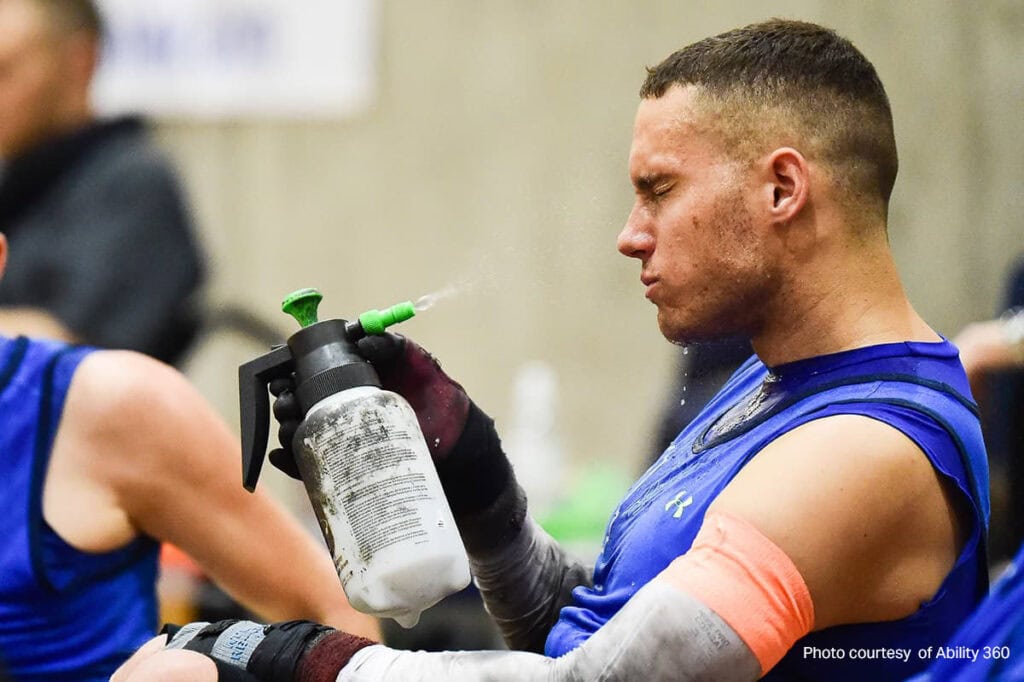
When you’re overheating, you have two best friends: water and wind. Quads have been keeping garden misters handy for decades. That’s because getting your skin wet mimics the evaporative cooling of sweat. But remember that bit about sweat being effective relative to surface area. Spraying your face might feel good, but when it’s really hot, dousing your whole body is going to cool you down more.
Misting yourself is most effective if you’re in an area with relatively low humidity. When it’s muggy out, your best bet is to pair spray with a fan to increase the evaporation rate. If you want to be out on the beach or hanging in a park, you can now buy a $25, battery-powered fan that will last all day and only weighs a pound and a half. Or, if you’re willing to be that person, Amazon will also sell you a $26, solar-powered fan hat.
Dan Gibson, a C5-6 quad, says he keeps his cooling methods simple: “When I need to cool down, I go for the obvious — dump a lot of cool water on my head and put a cold, wet towel on my neck and body.”
Gibson and other wheelchair users detail their go-to cooling methods, including carrying an emergency kit with instant ice packs and wearing an ice vest, in Bob Vogel’s article “Temperature Regulation Tips for Wheelchair Users.”
Other methods include sticking your hand in a bowl of cold water for ten minutes, which has been shown to lower your core body temperature by up to a degree. Cooling also works from the inside out, so stay hydrated with ice water or something in slushie form.
When you do get overheated, the first step is obvious: Get out of the heat. Find shade, then air-conditioning. But even back in the AC, it can take forever to feel like we’re finally cooling off because of our circulation issues. Getting into a cold bath or shower can speed the cooling process significantly and transform you back to feeling functional, instead of lethargic for the rest of the day.
Functional Tip
Tricky Tub Transfer
A cold bath does wonders if you’re seriously overheated, but getting into the tub is one of the trickiest transfers there is. In this video, Seth McBride shows his technique for transferring in and out of a bathtub without falling on his face.
Support New MobilityWait! Before you wander off to other parts of the internet, please consider supporting New Mobility. For more than three decades, New Mobility has published groundbreaking content for active wheelchair users. We share practical advice from wheelchair users across the country, review life-changing technology and demand equity in healthcare, travel and all facets of life. But none of this is cheap, easy or profitable. Your support helps us give wheelchair users the resources to build a fulfilling life. |