


The Cushion That Finally Got My Pressure Injury Healing
After two years of setbacks, Alex Ghenis puts Aquila's SofTech alternating-pressure cushion to the test.
July 13, 2026
Alex Ghenis
In early 2024, an under-inflated Roho cushion bit me in the rear. Sitting right on my chair’s seat pan led to an under-the-skin decubitus on my sit bone. It erupted into a tunneling sore.
In December 2024, I went to the ER when my caregiver couldn’t find the wound-packing rods he had placed the day before. The doctors couldn’t find the rods, but sent me home anyway. I tried a wound VAC, but the wound didn’t heal and turned into an abscess. I switched to a Ride cushion, but it didn’t help either.
In January 2026, surgeons prepping a new wound VAC found the wound-packing rods deep inside my wound — over 12 months after they went missing. But even with no trapped foam, a wound VAC vacuuming, and me mostly in full tilt/recline, the tunnel wouldn’t shrink. In fact, it got deeper, with 9 cm of undermining.
That’s when New Mobility asked me to review the Aquila SofTech, a custom-made, alternating-pressure cushion designed to help heal and prevent wounds. I knew I’d be the perfect tester. I said yes without thinking twice.
About the SofTech
SofTech cushions use a motor and air bladders to alternate pressure on key pressure points every 60 seconds, while relying on sections of low-density foam to offload major pressure points, like under the ischial tuberosities (sit bones). Each one is custom-made based on wheelchair dimensions, user weight, and the location of the user’s sit bones. The cushion comes with either a manual on/off switch or a weight-sensing automatic-start system, and a breathable cushion cover or a waterproof “incontinence” cover. If you choose the breathable cover, there is also an optional moisture control unit that blows air between the user’s legs.
The cushion consists of a control panel, a lithium-ion battery, a small motor to circulate air, air bladders and foam. The battery holds enough charge for about two days of use, though it’s recommended to charge every night. Like all foam cushions, SofTech cushions need to be replaced every couple of years.
One cool thing about the cushion is that it has three firmness settings, which you can change by pressing a small button on the control/charging panel. These provide different levels of comfort, cushion and support. This allows you to decide whether you want to stick with one firmness setting or switch it up depending on what you are doing (e.g., using medium indoors and soft on bumpy sidewalks).
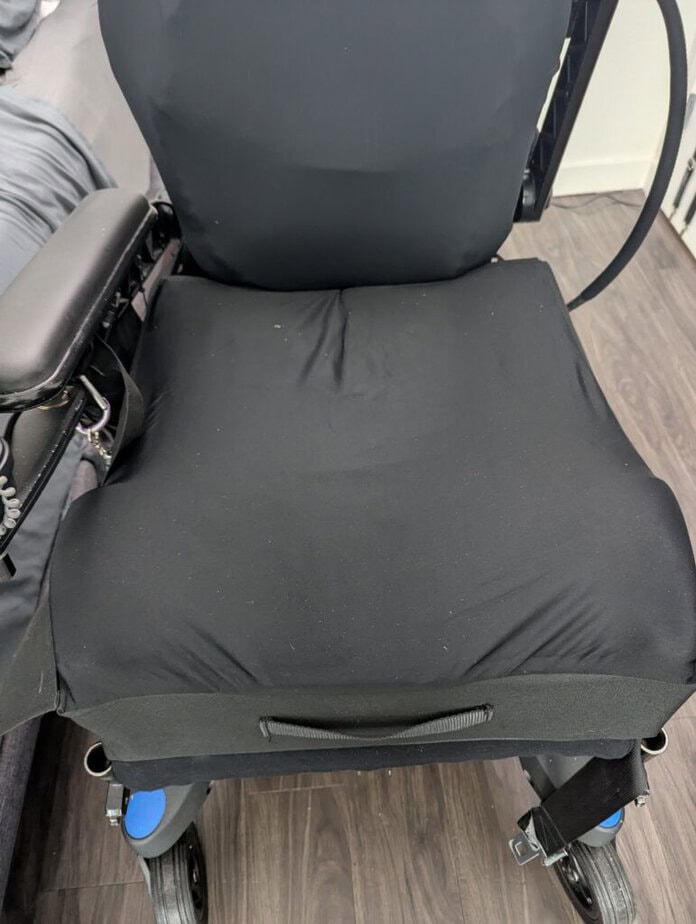
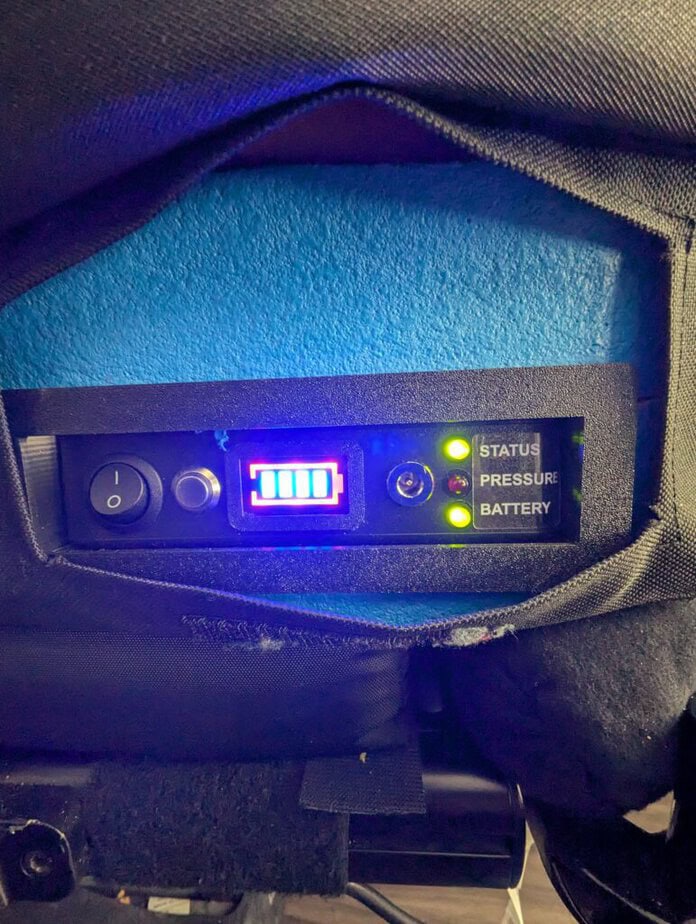
Aquila claims their cushions help with wound healing and keep wounds from starting in the first place, including in people who have already had major sores, tunneling wounds and/or flap surgeries, and those who have the kind of scar tissue that breaks down easily. That’s me: Not only do I have a tunneling sore down to my left sit bone, but I’ve had surface-level sores on both cheeks in the past. I’d be taking Aquila’s claim to task, as I’m managing a sore and trying to keep others at bay.
Not Just the Co-owner, But a User
The wound-healing, wound-preventing claims are bold. They’ve also been validated by a Cleveland Clinic study and the first-hand experience of Jarom Hlebasko, a C5 quadriplegic and one of Aquila’s co-owners.
He discovered Aquila cushions in 2018, almost 2 decades after his injury. After unsuccessfully trying numerous cushions and enduring five flap surgeries for recurring pressure sores, Aquila’s SofTech cushion allowed him to fully heal and get back to an active life. Jarom stayed sore-free for six years, but when he went to order a replacement cushion in 2024, he found that Aquila’s owner had shuttered the business.
Unwilling to imagine a future without the technology that changed his life, Jarom huddled up with his brother, Jacob, and decided to buy Aquila. They restarted the business in May 2025 after it had been dormant for about six months. Over the last year, Jarom has handled most of the business management while Jacob builds, modifies and maintains cushions for their customers.
The Hlebaskos are working to build relationships with businesses that can take measurements and manage the ordering process, but for now, most customers take their own measurements and fill out the online form themselves. In addition to cushion options, the form that asks about prior and current wounds, any flap surgeries, seat pan/cushion dimensions, user weight, and how far the user’s sit bones are from the back of the chair.
Before starting the form, I asked my caregiver to grab a measuring tape and get the dimensions of my Ride cushion while I was out of my chair (Ride cushions have a distinct divot for the ischia, which made that part of measuring easy). I couldn’t decide between the different features, so I asked Jarom over email about pluses and minuses for the on/off options (rocker switch vs. auto-start), cushion covers and moisture control unit. He told me he has an auto-start version and saw no downsides with it. He also said the foam cushion is water resistant so the occasional small accident — cleaned quickly — wouldn’t ruin it through the breathable cover. But regular and/or major incontinence required the impermeable cover. He added that the moisture control unit was a great addition with skin and hygiene benefits. I went for the auto start, breathable cushion cover and moisture control unit. A couple of weeks later, Jacob had built my cushion and sent it via UPS. I got it within a week.
My SofTech Experience
I’ve had the SofTech cushion for almost two months now and I’d say it’s been 95% great, with a couple of speed bumps. The great? Comfort and healing, full-stop. The cushion is much more comfortable than the firm, foam Ride in every situation: sitting upright, fully tilted and reclined, and when going over bumps — whether in the street in my van or just rolling down the sidewalk. I’ve landed on the softest SofTech setting for comfort, but even medium is a major improvement.
And then there’s the healing. I’ve been keeping a spreadsheet of my wound’s dimensions — the length and width of the entrance, the depth, and the horizontal undermining — that my wound nurse measures every Monday, going back to January. I’ve also kept a photo record to see what the entrance looks like each bandage change on Mondays, Wednesdays and Fridays. Within a week, the entrance looked healthier with better blood flow. Within three weeks, the undermining had shrunk from 9 cm to 8 cm.
There was one big hiccup, though. The auto-start — which turns the cushion on when it senses enough body weight — couldn’t decide if I was in the chair or not when I was in full tilt/recline. The motor would shut off and not give me the benefits of alternating pressure, then turn back on and give a high-pitched beep, then turn off and on and off again, beeping repeatedly through my workday. Needless to say, it was both annoying and reduced the effectiveness of the cushion itself. I needed to make a change.
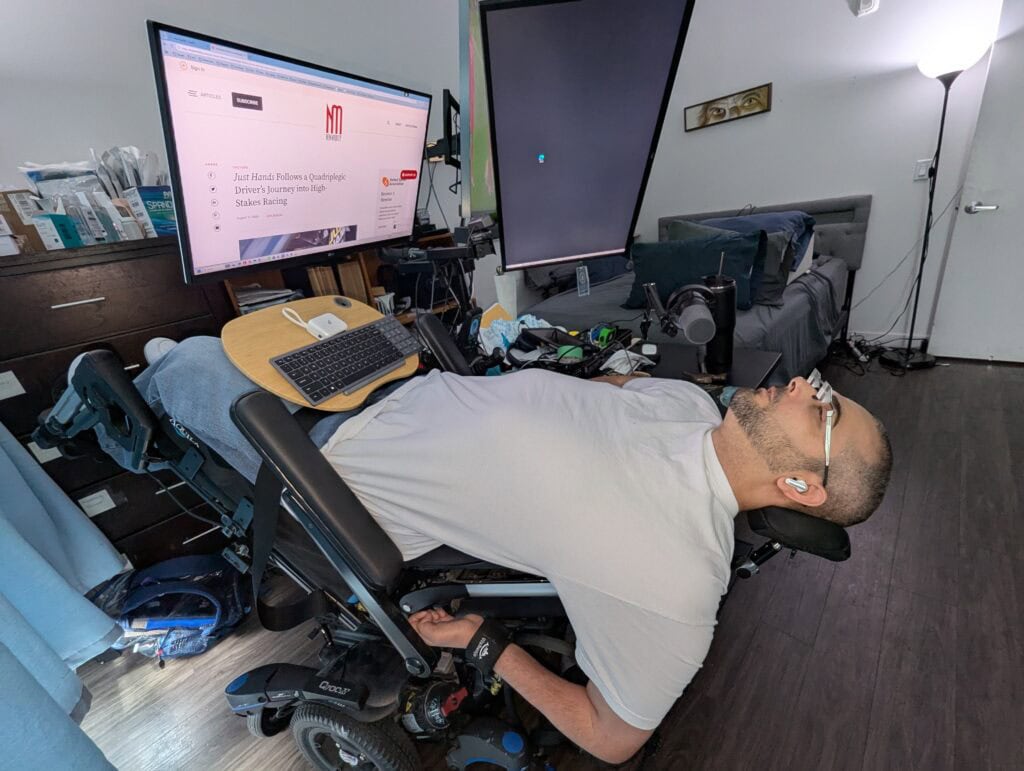
I told the Hlebaskos that I wanted to swap the control panel for one with a rocker switch given the problems when tilting. I also opted to buy an incontinence cover and remove the moisture control unit. The Hlebaskos offered to change the electronics for free considering the lack of warning, while I paid to remove the moisture control unit. They said they hadn’t encountered the tilt issue before but didn’t hesitate to change the ordering form to recommend the rocker switch for anybody who tilts beyond 45°. I felt heard and appreciated their responsiveness.
Including shipping, the whole thing took 5 or 6 days. In that time, I used the Ride cushion and tilted as much as I did with the Aquila. I was less comfortable and dealt with a mix of pressure and pain. I wanted the Aquila back, and fast.
I didn’t realize exactly how much damage had been done until my nurse measured the sore a couple days after I got the Aquila back: the undermining had grown 0.5 cm (to 8.5 cm deep), the entrance was wider, and the wound bed was visibly darker compared to before my week with the Ride cushion. The deeper undermining tracked my earlier experience. The wound entrance was on the buttock muscle, at one of the weight-bearing points on the Ride cushion, so the damage there made perfect sense. Above all, the regression was a gut punch.
No Going Back
As I write this, I’ve had the SofTech cushion back for about three weeks. The rocker switch works great and now the cushion alternates pressure while I’m tilted back. The only caveat is I need to turn it on each morning, which isn’t hard to remember. After a week to stabilize from the damage while using the Ride, the wound has steadily progressed: a measurement three weeks later put the undermining at 8.0 cm, a half centimeter better than before and a sign of renewed healing.
At this rate, the wound should be healed up in a few months. A few months ago, healing almost seemed impossible. Now it seems all but certain.
Just like Jarom was 8 years ago when he discovered Aquila, I’ve been amazed at the SofTech cushion’s impact. A wound that I couldn’t heal is healing, and there is plenty of evidence that is a result of the cushion. I’ve also been impressed with Aquila’s customer service and how the Hlebaskos have accepted and already incorporated my feedback. My only worry at this point is how I’ll get a replacement when the time comes, as my wheelchair service provider, National Seating and Mobility, isn’t yet an Aquila customer (Jarom is pitching to them). Because honestly, I’ll be damned if I’m going back.
[Editor’s note: Aquila provided this product free of charge for review. New Mobility did not receive compensation, and the company had no input on or advance access to this review. All opinions are the reviewer’s own.]

Thank you for sharing your story. As someone who has lived with a spinal cord injury for many years, I know how frustrating and emotionally exhausting it can be when a pressure injury refuses to heal. Articles like this remind us that there isn’t always a one-size-fits-all solution, and sometimes the breakthrough comes from being willing to try a different approach with the help of knowledgeable clinicians.
What gives me hope is that seating technology and wound care continue to improve. Every success story like yours adds to the collective knowledge of our community and may help someone else who has been struggling for months or even years.
Thank you for being open about your experience. Stories like this encourage all of us to keep asking questions, stay proactive, and never lose hope that a better solution may be out there. Wishing continued healing and many healthy years ahead.