


In Search of the Rabbit
[Editor’s Note: Longtime disability rights activist, writer and New Mobility contributor Mike Ervin passed Tuesday morning. His dark humor and quick wit combined with his insightful prose and willingness to call a spade a spade to make him a favorite of New Mobility readers for over two decades. His loss will be felt deeply. We’re sharing this 2009 Tim Gilmer profile of Ervin digitally for the first time to help keep his larger-than-life persona alive.]
November 5, 2026
Tim Gilmer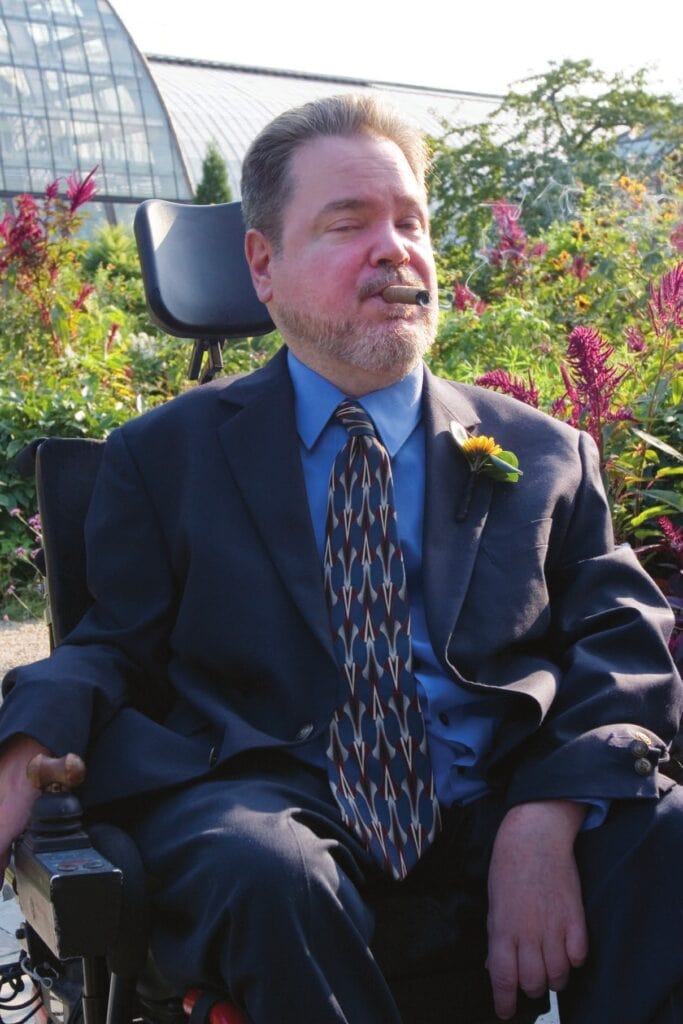
It’s Sunday in Chicago, 73 degrees, and I’m cruising in my rented car near Grant Park, where Barack Obama gave his acceptance speech, in search of an older 22-story building in the Printers Row district that once housed office space for Elliot Ness. I’ve come here to satisfy my curiosity about a writer/activist who lives in this building, someone I’ve “known” for nine years but have never met face to face. Of the nearly 150 writers I’ve worked with as editor of New Mobility, Mike Ervin is the most intriguing. His satirical wit and reputation as an inspired activist — he’s perhaps best known as the man who organized “Jerry’s Orphans” — are unique in the disability rights arena.
The 15-foot-high ceiling swallows you as you enter Ervin’s condo. At the far wall a large window stretches above his cluttered desk, where his laptop sits poised. Another wall is dominated by a series of Beethoven prints by Warhol and several abstract paintings by his first wife, Anna. A kite hangs near the top of the ceiling. About 300 CDs are packed on top of an old trunk, and there’s a makeshift bookcase with photos of Ervin’s two weddings, the second with Rahnee Patrick, now interim director of Access Living. In another photo, Ervin is smoking a cigar with Jimmy Hoffa-like slicked back hair, looking a little like a Chicago mob boss. A fluffy white toy rabbit with large teeth hangs out on the couch.
“What’s with the rabbit?”
“It’s a replica from Monty Python and the Holy Grail,” says Ervin, “one of my favorite movies. Rahnee’s sister gave it to me.”
I’m seeking clues to what makes him tick, and he leads me to 1984, the year of ADAPT’s first Chicago action. “It was a Chicago Transit Authority meeting. We’d given them a list of our demands and a deadline and we came back to confront them when they ignored the deadline. We showed up with noisemakers to disrupt their meeting, so they ‘took a recess’ and went down the hall looking for a more secluded location. It was perfect. We moved in, took over the dais and substituted our homemade name plates and had the press and the audience to ourselves. We held our own mock meeting and unanimously passed our resolution, granting ourselves all of our demands.” He smiles, looking like a proud chipmunk with his casually trimmed beard.
In the afternoon, Rahnee drives Mike and me and my wife, Sam, past the Sears Tower on the way to the old Biograph Theater. It’s now the Victory Gardens Theater, where Ervin’s The History of Bowling played as part of the Access Project, which he oversees. On the way he tells a story about the recent filming of Public Enemies, starring Johnny Depp as John Dillinger.
“The Biograph is where Dillinger was tricked into going and then ambushed and killed by the FBI in an alley close by,” he says. “They turned Lincoln Avenue into a set with storefronts. My good friend Tim Sullivan, a movie maniac, got on the set and befriended Depp, gave him an ADAPT T-shirt and established an e-mail connection. No one thought much of it. Then one day Tim let drop that ADAPT would really appreciate it if Depp cared to do something for us. Tim was thinking of a public service announcement, but the next thing he knew we got a check in the mail for $25,000. We made good use of it — put it toward the D.C. action, where Rahnee was arrested.”
At the Victory Gardens Theater, Mike introduces us to his “boss,” Sandy, who overrules a hypervigilant stage manager who earlier denied our request to shoot inside the theater. With Sandy’s OK, Sam snaps photos. “When they remodeled it,” says Ervin, admiring the first-rate auditorium, “they put in an elevator and made everything accessible. I can even get into the tech booth now,” he says, directing his gaze above the highest row of seating. “First time I’ve ever been able to do that in any theater.”
I’m beginning to see Ervin as the Perpetual Man in the Tech Booth, whether it’s activism, a stage play or a satirical essay. There’s an element of theatrics in just about everything he does, and he likes to direct. Like when he organized an army of protesters in wheelchairs and disrupted the MDA Telethon for the first time. It was a surprise attack. No one expected a bunch of docile wheelers to invade Jerry Lewis’ sacred Labor Day melodrama with chants of “Piss on Pity! Stop the Telethon!” Kevin Richardson’s documentary, The Kids Are All Right, highlights the uneasy confrontation by first setting the stage with vintage images of Ervin and his sister, Cris, on the set of an early MDA Telethon as innocent kids. If anyone had a right to protest the telethon’s degrading spectacle, who better than two former poster children?
Later in the afternoon, the four of us go out to dinner at one of Mike and Rahnee’s favorite spots, the Greek Islands Restaurant. Even the parking attendants seem genuinely glad to see them. Inside, the place is packed at 4:30 on a Sunday afternoon, but we are seated immediately. The head waiter seems to know just the right table. Soon we are feasting on appetizers, wine and brightly seasoned Greek specialties. Mike drinks beer from a straw while Rahnee occasionally cuts his food up and relates stories about how they got together. The meal is leisurely and relaxed, about as distant from fast food culture as it’s possible to get. Mike tops off his meal with a shot of ouzo. The chipmunk cheeks return.
When we leave, Mike and I in our wheelchairs squeeze through the waiting crowd. It’s now 6:30 p.m. and 40 people are waiting outside in a line. Mike and Rahnee not only know where to eat, they know when to eat.
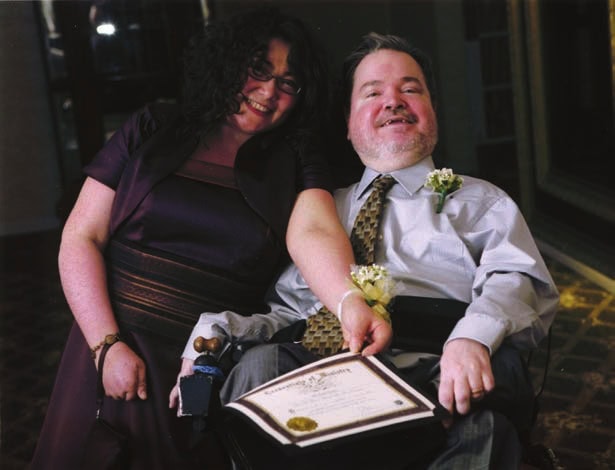
The next day Ervin holds forth in a panel discussion on Artists with Disabilities at Access Living. There are five panelists. Ervin occupies the middle position, sitting higher than everyone else in his year-old Invacare Ranger X, the king on his throne. Other disability rights notables are in attendance — Susan Nussbaum, who first encouraged Ervin to write plays when they collaborated on The Spunky and Plucky Show, and Carol Gill, a psychologist / researcher with deep ties to the community. Some of the other panelists, all gifted artists with disabilities, complain about how difficult it was to succeed. Ervin has no gripes to air. He seems grateful that The History of Bowling has found audiences in a number of major cities.
A recent performance of Bowling took place in Los Angeles, where it was well received. Danny Murphy, an actor/quad who has played several bit parts in movies, got the lead role. “I’d never been able to put my arms around a really great leading role,” Murphy tells me over the phone. “But I loved this play, especially the dialog. It presents disability like we are — real people.”
Ervin works hard as a writer. In June he travels 30 miles north of Chicago until he reaches Lake Forest, a wealthy community not far from the Wisconsin border. I call him while he’s there. “This is where they filmed Ordinary People,” he says. He’s there for a two-week writing gig sponsored by The Ragdale Foundation, the fourth-largest artist’s community in the United States. It’s his third consecutive year in the residency program. Built in 1897, the historic residence is a quiet retreat that has been preserved. An old garage has been turned into a studio and made accessible. That’s where Ervin’s room is. He pays $25 a day for meals.
“There are other artists here. Every night we have dinner together,” he says, “in a two-story building with a 50-acre prairie visible out the window.”
After we talk about his current writing projects, I ask, “What’s most important to you? What would you least like to give up?”
“ADAPT is the one thing I can afford to give up the least,” he says. “A lot of the hope we have comes from knowing we have power to make change to keep our lives together. It’s a preservation thing. But as far as what I like to do, writing would be the last thing I’d want to give up. I’d be willing to give up activism if we didn’t need it. It’s not like I go around wishing for something I can take action on. If I never had to go out and protest, I wouldn’t be bored. I have plenty of things to do. But there are so many things that are blatantly wrong.”
“Recently I got a letter from a reader,” I begin, “who claimed that ADAPT theatrics are not the way to make change. He said it takes people working on the inside, lobbying and working with legislators, to get bills passed.”
“But history has proven that any president who’s considered to be great has done so because pressure came from outside,” says Ervin. “Ending slavery, instituting the New Deal, signing civil-rights legislation, women’s suffrage. Presidents just don’t walk in one day and say, ‘Boy, I feel good today so I think I’ll give women the right to vote.’ They do it because women organized for decades and pushed them and demonstrated. Had MLK made the same speeches that he made, the same words, and stood on the street corner speaking about love by himself, nothing would have happened. He had 100,000 people behind him marching and demonstrating and doing radical things.”
Ervin is not all theatrics and confrontational politics. Anyone who reads his satirical column in NM knows he likes to have fun.
“”He’s a great practical joker,” says Sullivan, who has known Ervin since MD camp decades ago. “April Fools’ Day is his high holiday. There was this woman who was a diehard Cubs fan. Mike called and told her she had won two free tickets to see the Cubs and she had to call in for them. So she called and the guy on the other end had no idea what she was talking about.”
“Has he ever tricked you?”
“Many times. Once he had a friend call me and tell me there was a CTA meeting on Wells Street and the guy gave me the address. As I was leaving for the meeting, I said to my girlfriend, ‘Remember, it’s April 1st, beware if Mike calls on the phone.’ Then I headed out, not even realizing the joker had already struck. When I got to where the address was, I was on the wrong side of the street, the odd side, and the address was on the even side. As I turned and looked across the street, it dawned on me when I saw the sign for the Bijou Theater that I was just about to walk into an all-gay-male-cast movie theater for a fictitious CTA meeting.”
“Have you ever pulled one on him?”
“Trying to play a joke on Mike is really hard. You could help by sending him an e-mail telling him I said he was an egotistical asshole who snubs everybody. Yeah, he wears a pinky ring and makes everybody kiss it.” Sullivan laughs. “Tell him I said he’s just waiting around for Jerry Lewis to drop dead so he can take over his job.”
Ervin’s love of humor goes beyond practical jokes. There’s often purpose behind the fun. Rahnee says it’s an important part of their relationship and also a tactic he uses in activism. She should know. They co-led an ADAPT retreat session in how to use humor to make change.
“Once we had this meeting with an important transit authority bigwig,” she says. “He was a powerful man in a shiny suit, rings on his fingers and a big cigar. I think it was Mike who suggested that everyone go with a cigar of their own. So here’s this meeting with this important guy, and he’s talking, and he would pause and tap his cigar, and instantly these disabled people all had cigars out, tapping them. When he shifted in his seat, they shifted in their seats. Finally, he caught on, and that was a magical moment.”
More than simple mocking, the moment centered around the principle of equalization. “At the same time you’re making this powerful man smaller,” says Rahnee, “there’s a realization within your group that you are gaining power. If you believe you have equal standing, anything is possible. Mike has made several speeches about this.”
“He told me if you’re not having fun,” I say, “then why do it.”
“Right. Happiness is a way to be an indomitable force.”
In my last phone conversation with Ervin for this story, I finally understood. “Hey, Mike,” I said. “You know that soft furry white rabbit on your couch, the one with the big shark teeth?”
“Yeah,” he said, chuckling.
“Now I know. That’s you, man.”
(Editor’s Note: This article originally ran in the August 2009 issue of New Mobility)
