


Wheelchair-Accessible Autonomous Vehicles Are Here. Now What?
We take a ride in one of May Mobility's wheelchair-accessible AVs and explore the company's plans for the future.
June 9, 2023
Cheryl AngelelliJust 42 miles away from the Detroit factory that produced the first Ford Model T — which changed the way Americans lived, worked and traveled — another Michigan company is hoping to once again revolutionize transportation.
Founded in Ann Arbor, Michigan, in 2017, May Mobility is a leader in the development of autonomous vehicle technology and accessibility. In collaboration with Toyota Motor Corporation and BraunAbility, May Mobility has launched a fleet of modified Toyota Sienna minivans with rear-entry ramps and May Mobility’s AV technology. The accessible AVs are currently on the road in three of the company’s 10 test markets, serving users of all abilities. The rides are free in some cities, and others charge a nominal fee set by the municipality.
“We’re passionate about making transportation better for everyone, and providing innovative, accessible transportation solutions to rural communities is a key step in that journey,” says CEO Edwin Olson. May Mobility believes AVs can be a viable transportation solution for underserved communities, including people with disabilities.
Currently, accessible AVs are available in Ann Arbor, Michigan; Grand Rapids, Minnesota; and Arlington, Texas. Thirty percent of May Mobility’s active commercial fleet is wheelchair accessible, and the company plans to expand in other markets.
Accessible Independence
In communities where May Mobility has launched accessible AVs, riders like Myrna Peterson are already enjoying the benefits. Peterson, 73, is a disability advocate and quadriplegic who uses a power wheelchair and owns a wheelchair-accessible van, but needs a driver to take her places. She has used May Mobility’s wheelchair-accessible AV almost every day since the service launched in Grand Rapids, Minnesota, in October of 2022. She says it gives her gives her the freedom and independence to move around her community.
“I go to worship twice a week, I go downtown for city hall meetings and to go to restaurants or a movie,” says Peterson. “I’m able to go to Target, see my grandkids play sports at their school, and get to my work.”


Before May Mobility, Peterson’s options were limited. Local ADA bus service through Arrowhead Transit only runs until 5 p.m. and is not available on weekends. There are no accessible taxis in her community, and medical transport is too expensive, especially for those with limited income.
Peterson books her rides on her phone using May Mobility’s free app. Minutes later, an AV arrives with an Autonomous Vehicle Operator on board. Currently all of the company’s AVs, including their wheelchair-accessible ones, have an AVO. The AVOs monitor the vehicles and do a manual takeover should there be a safety issue. For passengers with disabilities, AVOs provide assistance entering and exiting, and with securing mobility devices. They are more than faceless operators — Peterson knows all the AVOs in her area by name, and looks forward to their daily conversations as she cruises about town.
There are still plenty of hurdles to overcome if May Mobility is to fully realize the potential of accessible AVs. The biggest obstacle by far is going truly autonomous. That means moving past AVOs and figuring out a way for wheelchair users to independently enter and exit vehicles and secure their own chairs.
May Mobility’s stated goal is to be completely driverless by the end of 2023, although their wheelchair-accessible AVs will continue to have AVOs on board to provide assistance. But the company is one of many interested parties working on an independent wheelchair-docking station and an automated belt-donning system that would replace AVOs.

Along with the University of Michigan Transportation Research Institute, United Spinal Association, BraunAbility and others, May Mobility was selected to participate in the U.S. Department of Transportation’s Inclusive Design Challenge to meet these goals.
The company has plans to enhance the AV’s interior accessibility features with speakers and a video display to help passengers with hearing and/or visual impairments to see and hear key journey moments such as arriving at a stop, or when doors are opening and closing.
No one knows how these future improvements will change the AV experience, but May Mobility can take encouragement from strong positive feedback by early testers. In five years, May Mobility has provided more than 320,000 rides, and since debuting in Ann Arbor last December, that market has around 85% repeat ridership.
Peterson estimates she has put about 12,000 miles on her power wheelchair just getting to places in her community. She says having access to an accessible AV now makes it safer for her to go out, and she doesn’t have to be out in the frigid cold during Minnesota’s harsh winters.
“I have a master’s degree in educational technology, so I’ve always been interested in what technology can do to make everybody’s life easier, especially people with different abilities,” she says. “AV technology is just so visionary, not only opening up the world and creating opportunities for people with disabilities but for (also) those who can’t or choose not to drive.”
I Got To Test One of the First Wheelchair-Accessible AVs … Here’s What Happened
On a crisp, sunny day in Ann Arbor came my chance to ride in one of May Mobility’s wheelchair-accessible AVs. Driving into the city in my personal vehicle, it was easy to spot the Toyota Sienna vans with giant logos and roof-mounted cameras, navigating the streets. My excitement was building. I didn’t know what to expect. Secretly, I envisioned KITT, the talking, self-driving Pontiac Trans Am from the popular 80’s sci-fi TV series Knight Rider, pulling up, asking me to get in, and off we’d go fighting the injustices of the world. Even though my ride would lack a glamorous Hollywood storyline, it was still pretty cool.
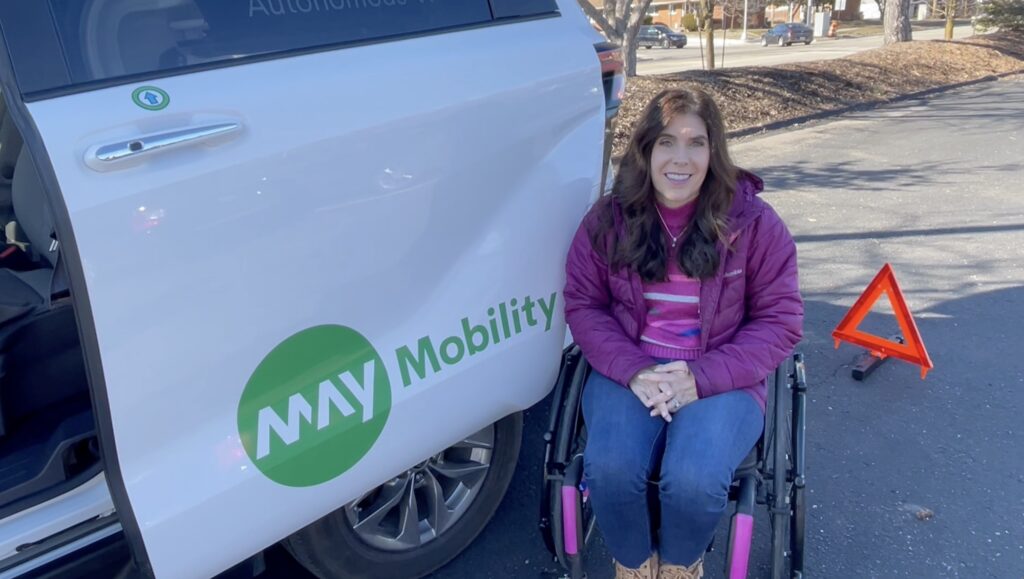
Upon arriving in Ann Arbor, the next step was to go to May Mobility’s mobile app to book my free, on-demand ride. Rides can also be booked by phone for those who do not have a smartphone. In Ann Arbor, there are 19 pickup and drop-off locations established, based on popular travel patterns and community input, to easily connect residents and visitors to restaurants, pharmacies, grocery stores, churches and more.
Using the app, I provided my current location and booked a ride to the University of Michigan’s campus. I also indicated I needed a wheelchair-accessible AV, as well as the number of passengers in my party. I received a confirmation text, followed by text updates on when my AV would be arriving.
Six minutes later, my green-and-white hybrid AV arrived with an AVO on board. My AVO was very knowledgeable about how the technology worked, and happily answered questions and demonstrated the vehicle’s many capabilities.
Once we were ready to roll, my AVO attached straps to the front of my manual chair that automatically pulled me up the ramp and into the vehicle. As a C6 incomplete quad, I was grateful for the powered assist. Once inside, the AVO used the Q’STRAINT manual securement system to strap down my chair, and provided me with a lap belt and shoulder belt. I definitely felt secure.
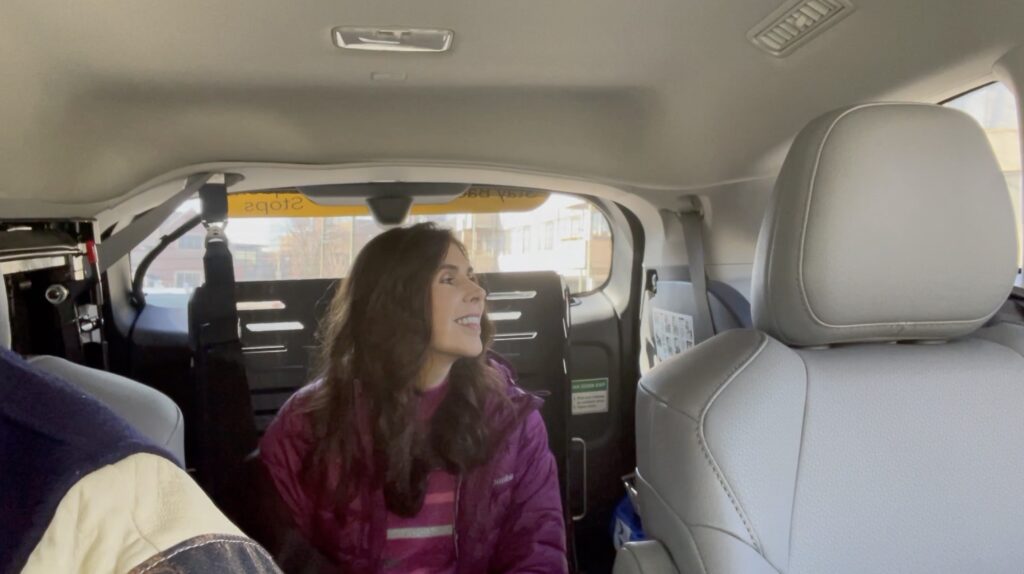
The interior of the wheelchair-accessible AV was spacious and could accommodate one rider in a manual or power wheelchair and two non-wheelchair users. My chair was locked down in the middle of the vehicle so I had a full, unobstructed view out the front windshield. The only negative was I could not see out the side windows. The right window was completely blocked by a seat folded to make room for my wheelchair, and the small left window was too high to allow a view. Once I was secured, the AVO climbed behind the wheel, and as we pulled safely out into traffic, he put the vehicle in self-drive mode.
AVs are equipped with a series of sensors, radars and cameras working together to create a 360-degree view of the world around the vehicle. Then there is May Mobility’s proprietary autonomy technology, called Multi-Policy Decision Making. MPDM imagines thousands of real-world driving scenarios every second. It looks at the most likely scenarios and the high-risk scenarios, and in milliseconds, the vehicle decides what to do.
I had a chance to experience firsthand how the AV’s self-drive mode reacted to situations in real time. On my 15-minute ride, it knew when to stop for pedestrians crossing the road. It saw construction barrels in the road and moved out of the way, and it knew when the speed limit changed and adjusted its speed. I hate flying because giving up control to someone else causes me anxiety, but I never felt anxious or nervous while riding in the AV. The ride was smooth, there was never any hard braking for a traffic light or stop sign, and the vehicle slowed to a comfortable stop every time.
All in all, the experience was really enjoyable. I drive my own modified vehicle, but if I did not have access to a car or public transportation, I could definitely see myself using this service. I would also use the service if I was headed somewhere that had limited ADA parking or no on-site parking.
United Spinal Association’s Advocacy for Accessible AVs
United Spinal believes autonomous vehicles could be life-changing for people with disabilities and has been working to ensure that accessibility is integrated throughout AV design and implementation.
“For tens of millions of people with disabilities and seniors, and those in transportation deserts, we are starving for the safe, on-demand, accessible and reliable transportation AVs can deliver,” says Kent Keyser, public policy fellow at United Spinal. “I say ‘starving’ because for untold millions, we don’t have the luxury of transportation alternatives.
“Transportation brings all that the world has to offer to our doorstep. That includes health care, education, employment and living our lives to the fullest by engaging in the communities in which we choose to live and thrive. … United Spinal is advocating for AVs to get us to wherever, whenever we want to go, at an affordable price.”
Keyser cites a recent study that found “mitigating transportation-related obstacles for individuals with disabilities would enable new employment opportunities for approximately 2 million individuals with disabilities, and save $19 billion annually in health care expenditures from missed medical appointments alone.”
Support New MobilityWait! Before you wander off to other parts of the internet, please consider supporting New Mobility. For more than three decades, New Mobility has published groundbreaking content for active wheelchair users. We share practical advice from wheelchair users across the country, review life-changing technology and demand equity in healthcare, travel and all facets of life. But none of this is cheap, easy or profitable. Your support helps us give wheelchair users the resources to build a fulfilling life. |


What was left out — a vehicle/car for the disabled person to purchase. Many people who drove and were able to transfer were put in a bind because the cars made no longer had 2door sedans with large back seat foot room (where the folded chair would easily fit and easily be put there) – instead the large gas guzzling vans were offered. Many manual wheelchair users can attest to this. Let’s see a AV with large backseat foot room again.