


A high quality, properly fitting cushion is arguably the most crucial complex rehab DME product for people with SCI — anything less can result in a life-threatening pressure ulcer. Unfortunately, Centers for Medicare and Medicaid testing guidelines for cushions are minimal. Moreover, an outdated CMS coding system lumps a myriad of cushions made by different manufacturers into the same “skin protection” codes, which gives the illusion that all cushions in a particular code provide similar tissue protection.
This flawed system encourages “building a cushion to meet the code” [skimping on quality development] rather than investing in research, design and clinical testing — a practice that advances technology and develops superior cushions. Not all cushions provide protection against pressure ulcers even as skin becomes less tolerant with age or from previous breakdown.
Related Articles:
|
“Testing procedures for cushions are insufficient in measuring design variability for skin protection,” says Tom Hetzel, CEO, chief science officer, clinical therapist and ATP for Ride Designs/Aspen Seating. “The tests can be completed by an independent lab in a couple of days at the cost of just a few hundred dollars.”
Cushion tests to qualify for Medicare funding include a Cal-117 fire safety test and a simulated immersion laboratory test, where two cylindrical devices, meant to simulate a human pelvis, must sink 40mm with a 31-pound load without bottoming out after simulated aging of 18 months (the minimum required warranty). “The current tests do not measure pressure, meaning you could end up with a cushion that passes the tests, yet puts tremendous pressure on bony areas of the pelvis and puts the user at risk of a pressure ulcer,” adds Kara Kopplin, senior director of efficacy and research for ROHO.

In order to make cushions safer for wheelchair users, ROHO — in conjunction with Sunrise Medical — invested huge sums of money and years of research to develop a better cushion testing device, one that measures “envelopment” (how well the cushion wraps and supports the pelvis to evenly distribute weight and reduce pressure on bony areas).
Called the Simulated Envelopment Laboratory, the new device is in the shape of a pelvis and has 18 pressure sensors imbedded at typical pelvic pressure points to show the actual pressure readouts on all 18 points when immersed in the cushion. The goal is equal pressure distribution on all areas without any high pressure points. “ROHO uses the new device to test all models of our cushions,” says Kopplin. “As of 2015 the International Standards Organization has published the new device as an international test specification, and in the U.S., RESNA is close to finalizing a published version as well.”
Outdated Coding Vs. Research and Development
Outdated coding encourages poor-quality cushions. There are at least 100 cushion models made by approximately 20 or more manufacturers in Medicare codes E2622 and E2624 for the type of high-end cushions used by a majority of wheelers with SCI. In 2015, they had a Medicare reimbursement rate of 80 percent of $368 and 80 percent of $371, respectively, and that rate is trending down, not up. “The current coding system is very dangerous because it does not differentiate between technologies,” says Hetzel.
“You have manufacturers with cushions made with cheap combinations of materials and questionable degrees of science and research competing with manufacturers that have invested a great deal of time and money into thoughtful, innovative, clinically tested designs,” continues Hetzel. “Some consumers and many funding sources believe all products grouped in a single code are equal — when nothing could be further from the truth.”
Get Involved• Write down your DME reimbursement story. Share it with your families, friends, social media networks, health care professionals and most importantly, your congressional representatives. Find contact info for your elected official here: www.unitedspinal.org/action-center/. • Get to know your senators and representatives. The most effective strategy to make an impact on any elected official is to build a relationship with that person. Write to them, call their office, schedule appointments to talk with them about this issue and show up at community events they’re speaking at, such as town halls. By spending time getting to know them, you may get their vote in support of your issue today or in the future. • Join the Advocacy Alliance (www.unitedspinal.org/advocacy-alliance/). To learn more, contact Jenn Wolff, United Spinal’s Advocacy Alliance Manager, at jwolff@unitedspinal.org. Look for Wolff at the Advocacy Alliance’s “Sound Off — Selfies and Stories” booth at Abilities Expos and consider sharing your story on video. |
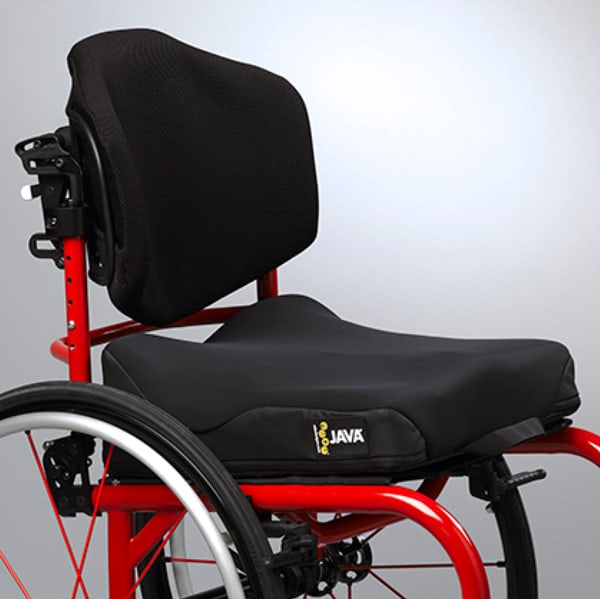
Research and development is a major expense for manufacturers focused on creating a cushion for tissue protection versus “meeting the code.” Ride Designs’ most recent cushion, the Java, took four years of research and development and employed three full-time engineers to get ready for another two years of university studies and research papers. It took two studies of 10 subjects averaging 18 years post-SCI to clinically prove the efficacy of the cushion before they were ready to bring the Java to market.
ROHO has a similar approach. “We spend a tremendous amount on evidence-based research, while other companies that make similar-looking products spend little in this area,” says Dave McCausland, vice president of government affairs, ROHO. “Research costs include manufacturing a prototype mold for every research cushion — something that is very expensive with no guarantee that it will ever reach the consumer. Additional costs include laboratory studies, clinical studies and support papers for the research.”
Quality control and customer service are other fluctuating variables. “We have three levels of inspection before a product goes out to the dealer and our warranty is at least 24 months and usually three years, when the required minimum is only 18 months,” says McCausland. “If you have a problem with a ROHO during the warranty period, we will ship a replacement right away. We could make a lot cheaper product, have it made in another country, have shorter warranties, and not do immediate warranty replacement, but is that what the wheelchair user wants?”
The goal for elite cushion manufacturers is to have CMS award a separate benefit category for complex rehab DME like the prosthetic industry has had for decades. Innovations in the prosthetic industry are funded favorably, and payment is authorized for the service component. “We don’t have that advantage,” says Hetzel. “When I present our seating concept to a room of prosthetists or orthotists, they all get it. They have been doing this concept of support to control posture and alignment for eons. So I ask them, ‘why aren’t you doing seating?’ Their answer? Insufficient reimbursement funding to cover the service.”
Ongoing Effects of Reimbursement Cuts
Reimbursement cuts not only jeopardize manufacturers’ ability to provide cushions with quality skin protection, it puts the financial brakes on advances in research that lead toward greater independence and mitigation of risk. “When I have a brilliant idea for seating, I have to consider minimal reimbursement versus development and research costs — without any confidence of a path towards reimbursement,” says Hetzel.
“It is important for wheelchair users to advocate for funding while they still have a chance,” says Hetzel. “Downward pressure on reimbursement is not only causing access issues to correct technologies, it is actually putting roadblocks up to further innovation. Access to quality seating is very tenuous right now. It may take the loss of this access for consumers to say, gosh, I should have advocated a few years ago.”
Support New MobilityWait! Before you wander off to other parts of the internet, please consider supporting New Mobility. For more than three decades, New Mobility has published groundbreaking content for active wheelchair users. We share practical advice from wheelchair users across the country, review life-changing technology and demand equity in healthcare, travel and all facets of life. But none of this is cheap, easy or profitable. Your support helps us give wheelchair users the resources to build a fulfilling life. |


Recent Comments
Neil on A Safe, Effective Reusable Catheter System
Richard Crumb on A Safe, Effective Reusable Catheter System
Richard Crumb on A Safe, Effective Reusable Catheter System