


The Cool Ass Cripple
By Tim Gilmer
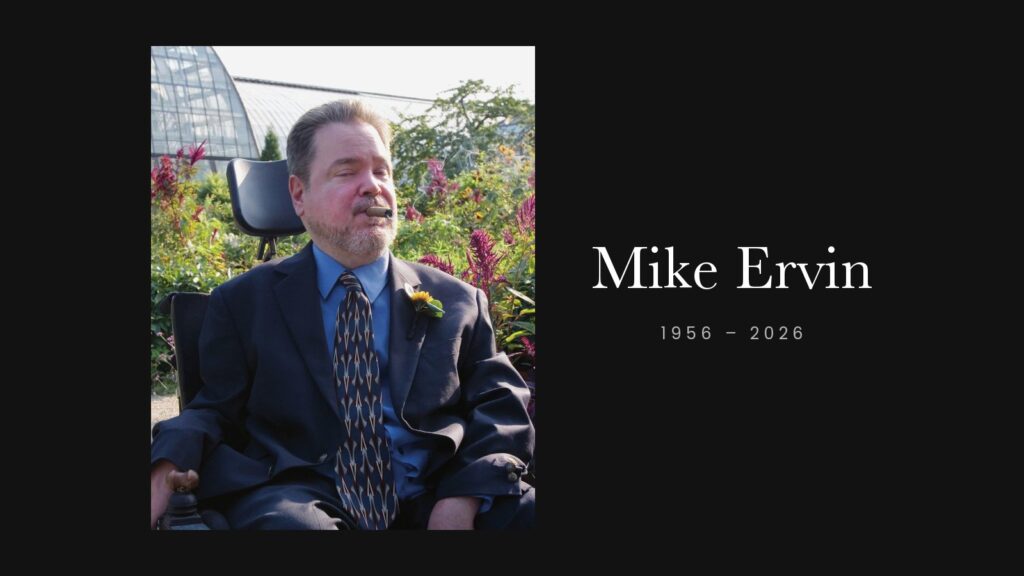
Mike Ervin, the cigar-chomping, gruff-voiced writer and disability activist who rolled through our midst with purpose and passion, wit and wisdom, died on Nov. 3, Election Day. He was 70.
He left us with an impressive body of writing marked by his unmistakable brand of satirical humor and his never-say-die commitment to fighting for disability awareness and equality. His voice was not contained wholly within his articles, plays, columns and blogs. He also put his body on the line in numerous ADAPT actions and public demonstrations — some scripted, others spontaneous — always acting in innovative ways that exposed our mutual enemies: ignorance, bias, hubris, hypocritical pronouncements and corruption.
Besides writing for New Mobility for 25 years, Ervin was a regular contributor to The Progressive, a left-wing magazine that has featured nationally known politicians and journalists since its founding in 1909. From February through October of this year, he published 20 columns in The Progressive. His last column, “When You Take Away Drivers,” ran Oct. 30, just three days before he was admitted to an ICU at Northwestern Hospital. It took on autonomous vehicles, pointing out the need for human drivers to help load wheelchair users and tie down our chairs.
For nearly 18 years, I edited all of Ervin’s columns and stories for New Mobility. I can truthfully state that he made my job easy. His gift for concise writing blended perfectly with his trademark satiric edge. Often, I simply read through a column, laughed or chuckled, and made no changes. I would sometimes read his columns aloud to my wife, who loved his humor. He had a gift for brief phrases that were made to be heard. He had a way of skewering a topic or person bloodlessly while making a point, sometimes with a single word.
Jean Dobbs, who guided NM from its infancy in 1990, when she was managing editor, to her retirement as publisher in 2025, included Ervin’s voice in NM for about 25 years. “Every great movement needs a great satirist,” she says. “Transmuting righteous anger into humor takes fierce intelligence, infinite patience and an unflappable moral compass. Mike Ervin was our voice.”
Ervin’s activism went all the way back to ADAPT’s founding and the battle for accessible transportation, but he will always be remembered for his in-your-face demonstrations, most notably the way he exposed the Jerry Lewis MDA Telethon as a shameless play for proceeds that exploited crippled children as objects of pity whose lives became useless to the telethon once they aged out of their precious cute years. Ervin — he and his sister Cris were certified poster kids — changed “Jerry’s Kids” to “Jerry’s Orphans,” a more accurate term when the money and attention disappeared. But for Ervin, it was more about respect — meaning the lack of it.
In a February 2019 column for NM, “The Secret to My Longevity,” Ervin writes, at 62, “If anybody asks me the secret to my longevity, I have a clear and simple answer: ‘Hell if I know.’” Then he goes on to list the things he doesn’t do: no physical therapy or exercise, no drinking eight glasses of water each day, no group whining, no strict diet. He eats and drinks whatever he wants, flatly confessing: “The other day I had a dessert of cheesecake and whiskey. Sometimes I even eat White Castle cheeseburgers. It’s my way of thumbing my nose at death.”
And then comes his secret: “Maybe listening to jazz is the secret to my longevity. I listen to a lot of jazz. Jazz is good for the soul. Jazz fans are cool and calm. You never hear about jazz fans rioting because they went to a concert and the musician didn’t show up. I think listening to jazz activates the same pleasure centers of the brain as having a dessert of cheesecake and whiskey.”
Being cool was quintessential Mike Ervin. He was not only the Smart Ass Cripple; he was the Cool Ass Cripple. He liked his jazz cool and funky. That was where he retreated to restore his soul in between times of stirring up good trouble.
Mike was known nationally, but Chicago’s disability community knew and loved him unconditionally. We especially owe his wife, Rahnee Patrick, our condolences, and our gratitude for her steadfast partnership and love.
Tim Gilmer is the editor emeritus of New Mobility.
The Troublemaker We Needed
By Reveca Torres
The morning I got a message that Mike Ervin died, I drove my parents to an appointment and on the way there I told them all about Mike — the activist, the writer, the leader, my friend …
Always in the Center of Everything
As a new theater arts graduate, I had just moved back to the Chicago area and was looking for internships or jobs in theater. I came across the Access Project, a program at Victory Gardens Theater that invited writers with and without disabilities to work on their plays. I decided to give it a try, kind of thinking it was gonna be one of those pity programs for people with disabilities where everyone gets a pat on the back. I was quickly and pleasantly surprised that there was a good mix of people who were writing interesting things and critiquing each other’s work. In the middle of everything was the founder of the program, Mike Ervin. Far from running a pity program, he was changing the arts scene in Chicago.
Initially I didn’t really know who Mike was, but eventually I found out that he was kind of a big deal and an activist for the disability community. I was intimidated.
For years I observed Mike and we crossed paths here and there. I started building my advocacy muscles and getting to know other advocates around Chicago. I came to admire those groups that would organize and gather. Sometimes they’d be up early in the morning on cold days at a rally. Some of them had many arrests under their belts in the name of equality. As a co-founder of Chicago ADAPT, Mike was front and center, wearing one of those hats that cover your ears, chanting something while someone held the microphone to his mouth. I loved Mike’s clever fundraising emails, but I donated to the cause because he and Chicago ADAPT were willing to be out there for all of us.
I spent a few hours rereading some of the entries in his blog, Smart Ass Cripple, today and was reminded how much I enjoy the short, punchy content. It has style. Reading would often result in a laugh, and almost always I’d forward it to a friend. I knew I could expect a new perspective or idea — or maybe something familiar but retold in a raw and somewhat rebellious form. Suddenly “cripple” was not a bad word but an invitation to play with language and claim it as ours.
Flipping through New Mobility every month, I knew to recognize Mike’s column by the photo of him in a fishing hat with a cigar in his mouth. When he was assigned to write about me as the Person of the Year, I was a little bit nervous because I admired him and wondered what he thought of me. He interviewed me at the Old Town School of Folk Music after my harmonica class and made me feel at ease. It was a fun conversation, and he wrote about my art and BACKBONES in a beautiful way. I left thinking we would have made a good folk band if I played an instrument that didn’t make me hyperventilate and he supplied offbeat, witty lyrics. Of course, we would have wrangled other cripples to join us with makeshift instruments, and there would have been groupies.
My organization, BACKBONES, has had a booth at the Abilities Expo over the years, and I came to expect a visit from Expo Ambassador Mike every year. He’d come around the aisle, slightly tilted to the side in his orange shirt, and stop directly in front of me. Sipping and puffing, moving his chair forward and back, or reclining just slightly only to sit upright again. Always moving. There were hellos, catching up with each other and then sharing the hot gossip from other booths — I think that was part of the job description. After some hearty chuckles he would leave, making his rounds, only to pass by later giving me a head nod and an eyebrow raise.
A Lasting Legacy
Mike sat next to me at the premiere of my film just about a week ago. “Did you see him?” I asked my parents. “Matt [the film editor] gave him a shout-out during the Q&A. We met and became friends because of Mike and the Access Project over 20 years ago!”
When I saw Mike in the audience that night, I rubbed his arm — my sort of “wheelchair hug” — because I just wanted to squeeze him. I was so happy to see him and then became nervous for him to see the film. I wanted him to be proud of me — the way a kid wants her dad to be.
As I finished telling my parents about Mike’s activism work with buses and public transportation, we got to the appointment. All the accessible parking spots were taken, and there was a LONG BUS PARKED ACROSS THREE SPOTS! I got all mad and said, “That bus is not supposed to be there. I am going to have some words with someone when I get inside.”
We parked, and as we got out of the van my parents said, “Uyyy, pelionera [roughly, troublemaker] … did you learn that from Mike?”
I’ve had a pit in my stomach all day, but that moment made me chuckle and smile …
Yes, I did learn that from Mike.
Reveca Torres is a Mexican American artist, filmmaker and disability advocate whose work explores identity, creativity and lived experience. She is the founder of Backbones, a nonprofit organization empowering people with spinal cord injuries and other disabilities through connection, storytelling and community, and the director and producer of the documentary While We Are Here (2026).
